1. Executive Summary: The API Architecture Landscape in 2026
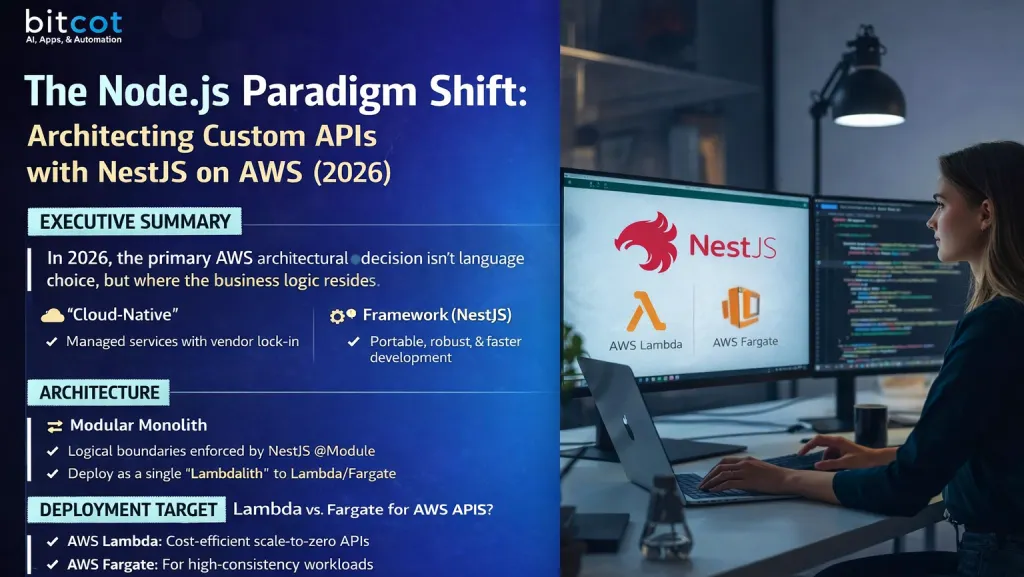
The domain of backend engineering and API development has undergone a profound transformation as we settle into the mid-2020s. The simplistic “cloud migration” phase, characterized by lifting virtual machines from on-premise data centers to EC2 instances, has largely concluded. In its place, a more rigorous, mathematically driven era of “cloud-native” engineering has emerged. In 2026, the successful architect does not merely rent servers; they orchestrate distributed systems where the choice of programming language, runtime environment, and compute primitive (serverless vs. containerized) dictates the fundamental unit economics and user experience of the application.
This report provides an exhaustive, expert-level analysis of building custom APIs on Amazon Web Services (AWS), specifically addressing the tri-fold decision matrix facing modern engineering teams: the choice of runtime (Node.js/NestJS, Python/FastAPI, or Go), the choice of hosting paradigm (AWS Lambda or AWS Fargate), and the adherence to cloud-native best practices. This analysis is not abstract; it is grounded in the specific technological reality of 2026, integrating critical developments such as the maturation of AWS Lambda SnapStart for Python 1, the deprecation of proprietary SDKs in favor of OpenTelemetry 2, and the evolving pricing models of ephemeral compute.3
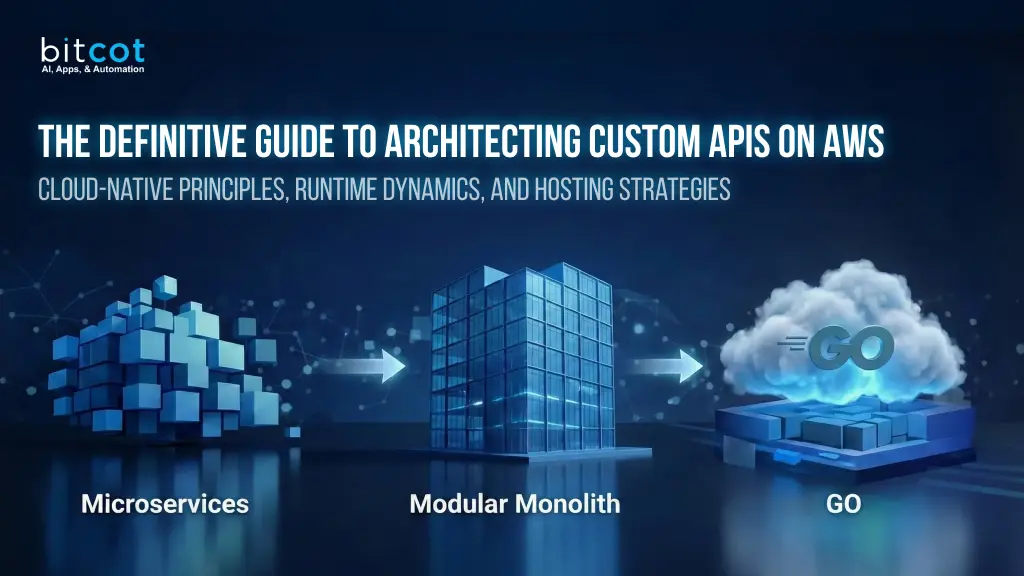
Our research indicates a diverging market. While the “microservices” dogma of the 2010s advocated for extreme granularity, 2026 sees a pragmatic consolidation toward “modular monoliths” or “macro-services” to reduce the operational overhead of distributed transactions.4 Simultaneously, the performance boundaries between interpreted and compiled languages are blurring due to hyper-optimized cloud runtimes, yet the distinction in developer velocity and ecosystem capability remains stark.

The following sections will deconstruct these layers, offering a blueprint for architects who must balance the immediate need for feature velocity against the long-term imperatives of scalability and cost containment.
2. Cloud-Native Development Principles: The 12-Factor App in the AWS Era
To understand the trade-offs between NestJS, FastAPI, and Go, one must first establish the architectural standards against which they are measured. The “12-Factor App” methodology, originally proposed by Heroku engineers, remains the bedrock of cloud-native development. However, the interpretation of these factors has evolved significantly with the advent of AWS managed services. In 2026, building a “12-Factor App” is less about generic guidelines and more about specific AWS integration patterns.5
2.1 Codebase: The Monolith vs. Microservices Dialectic
The first factor, “Codebase,” mandates a one-to-one correlation between a version control repository and a deployed service. In the context of AWS, this principle is currently the subject of intense debate regarding granularity. The industry is witnessing a “Vibecoding” trend, a shift back toward developer experience and simplicity, which often favors monorepos or modular monoliths over fragmented microservices.7
For an API built on AWS, this means the repository structure must support the deployment strategy. If utilizing a monorepo (facilitated by tools like Nx for Node.js or Bazel for polyglot codebases), the CI/CD pipeline must be intelligent enough to deploy only the affected services. This is critical for AWS Lambda deployments, where the “Codebase” factor intersects with the “Dev/Prod Parity” factor. A change in a shared library within a monorepo must trigger redeployments of all dependent Lambda functions to ensure consistency, a process that can become unwieldy without sophisticated tooling.
2.2 Dependencies: Isolation and Package Management
The second factor requires explicit declaration and isolation of dependencies. In the AWS environment, this factor has direct performance implications, specifically regarding “Cold Starts”, the latency incurred when a new execution environment is initialized.
- Node.js/NestJS: The package.json defines dependencies, but the sheer size of node_modules is a liability. NestJS, being a feature-rich framework, pulls in a substantial dependency tree. Best practices in 2026 dictate the use of bundlers like esbuild or SWC to bundle the entire application into a single JavaScript file, shaking out unused code to minimize the deployment package size.8
- Python/FastAPI: While requirements.txt or pyproject.toml (via Poetry) manages dependencies, Python packages often include compiled C-extensions (e.g., NumPy, Pydantic). These must be compiled against the specific architecture of the AWS runtime (Amazon Linux 2023 on Graviton2/arm64 or x86_64). Failure to isolate these binary dependencies leads to runtime failures. Furthermore, heavy dependencies significantly degrade Lambda startup time, necessitating the use of Lambda Layers or Container Images to manage the artifact size.9
- Go: Go excels here by design. Its dependency management via go.mod concludes with the compilation of a single, static binary. This binary embodies the ultimate realization of the dependency isolation principle, as it requires no runtime interpreter or external libraries on the host OS, aligning perfectly with the minimalist provided.al2023 runtime on AWS.10
2.3 Configuration: Strict Separation from Code
The third factor demands that configuration be stored in the environment. Hardcoding configuration constants is a cardinal sin in cloud-native architecture.
- AWS Systems Manager (SSM) Parameter Store: This is the standard repository for non-sensitive configuration data (e.g., feature flags, external API endpoints).
- AWS Secrets Manager: This service is mandatory for database credentials, private keys, and API tokens. It offers built-in rotation capabilities, crucial for security compliance.
- Implementation: In a robust AWS architecture, these values are not baked into the Docker image or Lambda zip file. Instead, they are injected as environment variables during the container startup (Fargate) or function initialization (Lambda). For high-volume Lambda functions, retrieving these values at runtime can introduce latency and cost; therefore, utilizing the AWS Parameters and Secrets Lambda Extension is a best practice to cache these values within the execution environment.11
2.4 Backing Services: Attached Resources
The fourth factor treats backing services (databases, queues, caches) as attached resources. This decoupling is essential for the “Dev/Prod Parity” factor. It allows a developer to run a local Docker container for PostgreSQL during development, while the production application connects to an Amazon Aurora Serverless v2 cluster. The application code remains agnostic to the provider of the service; it only knows the connection string.
In 2026, the definition of “Backing Services” has expanded to include AI models. For an API integrating Generative AI, the Foundation Model (e.g., hosted on Amazon Bedrock) is treated as a backing service. The API creates a binding to the model endpoint just as it would a database, adhering to the same principles of connection pooling and timeout management.13
2.5 Processes: Statelessness and Concurrency
The sixth factor asserts that processes must be stateless and share-nothing. Any data that needs to persist must be stored in a stateful backing service. This principle is non-negotiable for AWS Lambda and Fargate Spot instances, which can be terminated or replaced by the orchestrator at any moment.
- Session State: Sticky sessions are an anti-pattern. User session data must be externalized to Amazon ElastiCache (Redis) or DynamoDB.
- Concurrency: Scaling is achieved via the process model.
- Node.js: Scales via the event loop, handling thousands of concurrent I/O connections on a single thread. However, CPU-intensive tasks block this loop, violating the concurrency model.14
- Go: Scales via Goroutines. These are lightweight threads managed by the Go runtime, allowing a single process to handle tens of thousands of concurrent operations with minimal memory overhead, making it arguably the most compliant language for this factor.15
- Python: Traditionally limited by the Global Interpreter Lock (GIL), Python in 2026 leverages asyncio and ASGI servers (like Uvicorn) to achieve concurrency parity with Node.js for I/O-bound workloads.15
2.6 Disposability: Fast Startup and Graceful Shutdown
The ninth factor, Disposability, focuses on maximizing robustness with fast startup and graceful shutdown. This is the battleground where the runtime choice (Go vs. Node vs. Python) is most critical in a serverless context.
- Fast Startup: In AWS Lambda, “Cold Start” latency is the penalty paid for poor disposability. Go and Rust provide near-instant startup. Node.js is acceptable but degrades with framework weight. Python has historically struggled but has been redeemed by Snapshotting technologies (discussed in Section 4).17
- Graceful Shutdown: When AWS Fargate scales in (removes tasks) or creates a new deployment, it sends a SIGTERM signal. The application code must intercept this signal, stop accepting new requests, finish processing in-flight transactions, and close database connections cleanly. Go’s context package provides a superior standard library mechanism for propagating cancellation signals compared to the signal handling in Node.js or Python.15
3. Runtime Analysis: The Tri-Fold Decision Matrix
Selecting the runtime for a custom API is not merely a preference; it is a strategic decision that impacts the hiring pool, the cloud bill, and the user experience.
3.1 Node.js with NestJS: The Enterprise Standard
Philosophy: Node.js revolutionized backend development by unifying the language of the frontend and backend. NestJS emerged to bring order to the chaos of the JavaScript ecosystem. Heavily inspired by Angular, it imposes a strict modular architecture using TypeScript, Dependency Injection (DI), and decorators.18
- Pros:
- Structure: NestJS enforces an “enterprise” structure. It prevents the “spaghetti code” common in raw Express applications. This makes it ideal for large, distributed teams where standardization is paramount.16
- Ecosystem: The Node.js ecosystem (npm) is the largest in the world. NestJS has first-party integrations for everything from GraphQL (Mercurius/Apollo) to Microservices (gRPC, Redis, NATS).15
- Talent Pool: JavaScript/TypeScript developers are ubiquitous. Hiring for NestJS is easier than for Go or Rust.19
- Cons:
- Heaviness: The very features that make NestJS powerful (DI, Decorators) make it heavy. It performs extensive reflection and scanning at startup. On AWS Lambda, a standard NestJS app can take 2-4 seconds to initialize (Cold Start), which is often unacceptable for user-facing APIs.8
- Performance: While V8 is fast, Node.js is single-threaded. CPU-heavy tasks (e.g., image processing, heavy cryptographic calculation) will block the event loop, potentially starving other requests.14
- Best Practices for AWS:
- Bundling: Do not deploy node_modules to Lambda. Use esbuild or Webpack to bundle the application into a single file. This drastically reduces I/O time during cold starts.8
- Lazy Loading: Configure NestJS to lazy-load modules that are not immediately required for the initial request.
- Adapter Pattern: Use the aws-lambda-fastify adapter instead of Express to squeeze out better throughput.
3.2 Python with FastAPI: The Data & AI Powerhouse
Philosophy: FastAPI is a modern framework designed for the era of type hints. It leverages Python 3.6+ features to offer a developer experience that rivals statically typed languages while maintaining Python’s dynamism. It is built on top of Starlette (for routing) and Pydantic (for data validation).15
- Pros:
- Developer Velocity: The automatic generation of OpenAPI (Swagger) documentation is a massive productivity booster. The type hints allow IDEs to provide excellent autocompletion.15
- AI Integration: Python is the lingua franca of AI and Data Science. If the API involves PyTorch, TensorFlow, Pandas, or LangChain, using Python eliminates the “impedance mismatch” of bridging a Node/Go backend to a Python data service.14
- Modernity: It fully embraces async/await, making it highly efficient for I/O-bound tasks typical in microservices.22
- Cons:
- Raw Performance: Despite being “fast for Python,” it is still Python. It lacks the raw computational throughput of Go or C++ due to the interpreter overhead.16
- Validation Overhead: Pydantic is powerful but can be CPU-intensive if validating massive JSON payloads.
- The 2026 “SnapStart” Revolution: The most significant development for Python on AWS is SnapStart. Historically, Python’s initialization (loading heavy libraries like Boto3 or Pandas) was a major cold start bottleneck. SnapStart (supported on Python 3.12+) initializes the function code, snapshots the memory state, and caches it. Subsequent invocations resume from this memory snapshot. This effectively creates “warm” performance for “cold” invocations, neutralizing one of Python’s biggest weaknesses on Lambda.1
3.3 Go (Golang): The Cloud-Native Native
Philosophy: Go was designed by Google specifically for networked, distributed systems. It prioritizes simplicity, compilation speed, and concurrency. It produces a single, static binary with no external dependencies.
- Pros:
- Performance: Go rivals C++ and Java in raw performance but compiles much faster. It uses a small memory footprint, which directly translates to cost savings in AWS Lambda (where memory allocation determines cost) and Fargate (higher density).15
- Concurrency: The Goroutine model allows handling tens of thousands of concurrent requests without the “Callback Hell” of JavaScript or the complexity of Python’s event loop. It is the gold standard for high-throughput systems.15
- Cold Start: Go binaries start almost instantly. On the provided.al2023 runtime, a Go function can be processing traffic in under 100ms from a cold state.9
- Cons:
- Boilerplate: Go eschews “magic.” There is no comprehensive framework like NestJS or Django. Features like dependency injection, ORMs, and routing often require manual wiring or disparate libraries, leading to more verbose code.15
- Talent Market: While growing, the pool of experienced Go developers is smaller and often more expensive than Node.js or Python developers.19

4. Compute Hosting Paradigms: Lambda vs. Fargate
Once the runtime is selected, the next critical architectural decision is the hosting platform. In AWS, this is largely a choice between the Function-as-a-Service (FaaS) model of AWS Lambda and the Container-as-a-Service (CaaS) model of AWS Fargate.
4.1 AWS Lambda: Event-Driven Simplicity
AWS Lambda represents the purest form of serverless computing. You upload code, and AWS handles the execution infrastructure.
- Ideal Use Cases: Sporadic traffic, event-driven processing (S3 uploads, SQS messages), and APIs with idle periods.
- Pricing Dynamics: Lambda pricing is granular, based on gigabyte-seconds of execution time. This makes it incredibly cost-effective for low-to-medium traffic, as you pay zero when no requests are being processed.
- Concurrency Limits: Lambda scales horizontally by creating new execution environments. However, this is bounded by the account’s concurrency limit (default 1,000 concurrent executions per region). A massive spike in traffic can lead to throttling if this limit is reached.
- The “Init” Billing Change: As of August 2025, AWS charges for the initialization phase (the “Cold Start”) of Lambda functions. This fundamentally changes the economics of heavy frameworks. A poorly optimized NestJS app that takes 5 seconds to start will now incur significant costs just to boot up, even before processing a request.3
4.2 AWS Fargate: Predictable Container Orchestration
AWS Fargate removes the need to manage EC2 instances for ECS or EKS clusters. You define the CPU and Memory for a task, and Fargate runs it.
- Ideal Use Cases: Long-running services, high-throughput APIs with consistent traffic, and applications that require background threads or persistent connections (WebSockets).
- Pricing Dynamics: Fargate charges for vCPU and Memory per hour. While the hourly rate is higher than an EC2 spot instance, it eliminates the operational overhead of cluster management.
- The “Break-Even” Point: Analysis shows a distinct intersection in cost efficiency. For high-volume APIs (typically exceeding 10-50 million requests per month, depending on execution time), Fargate becomes cheaper than Lambda. A single Fargate task (e.g., 1 vCPU, 2GB RAM) can often handle hundreds of concurrent requests via Node.js or Go’s concurrency models, whereas Lambda would require spinning up hundreds of separate instances, each billing for memory and duration.24

4.3 The Hidden Cost of Networking in Fargate
A critical architectural detail often missed by teams migrating to Fargate is the NAT Gateway tax.
- The Problem: Security best practices mandate running Fargate tasks in private subnets. However, these tasks need internet access to pull Docker images from Amazon ECR or communicate with third-party APIs. This traffic must traverse a NAT Gateway.
- The Cost: NAT Gateways charge an hourly fee plus a data processing fee ($0.045/GB). For a deployment pipeline that frequently pulls large Docker images (e.g., a 1GB TensorFlow image), or an application that processes high volumes of external data, the NAT Gateway cost can easily exceed the Fargate compute cost.26
- The Solution: Implement VPC Endpoints (PrivateLink).
- Gateway Endpoint for S3: Free of charge. Allows access to S3 (and ECR image layers stored in S3) without going through the NAT Gateway.
- Interface Endpoint for ECR: Allows communication with the ECR API via the private network.
- By keeping this heavy traffic within the AWS private network, organizations can reduce their networking bill by orders of magnitude.28
5. Advanced Networking and API Exposure
The robust API requires a sophisticated “front door.” In AWS, this layer manages traffic, security, and protocol translation.
5.1 API Gateway vs. Application Load Balancer (ALB)
The choice of ingress controller is pivotal for performance and cost.
- Amazon API Gateway (REST/HTTP APIs): This is a fully managed service that offers advanced features like API keys, usage plans, request validation, and direct integration with AWS services (e.g., putting a message directly onto an SQS queue without a Lambda intermediary).
- Cost: The pricing model is request-based. For high-volume APIs, this can become prohibitively expensive ($3.50 per million requests for REST APIs, $1.00 for HTTP APIs).
- Limitations: It has a soft limit of 10,000 requests per second (RPS) per region. While this can be raised, it acts as a constraint for hyper-scale applications.29
- Application Load Balancer (ALB): Working at Layer 7, the ALB is the natural partner for Fargate. It supports path-based routing and can distribute traffic to target groups.
- Cost: Pricing is based on “Load Balancer Capacity Units” (LCU). For high-throughput scenarios, ALB is significantly cheaper than API Gateway, often by a factor of 10x or more.
- Scale: ALBs are designed to handle millions of requests per second. They scale automatically and aggressively, making them the preferred choice for massive scale.30
- Lambda Response Streaming: A new capability in 2025 allows Lambda functions (via Function URLs) to stream responses back to the client. This is critical for Generative AI applications (streaming tokens from an LLM) or delivering large datasets without buffering the entire payload in memory. Note that API Gateway supports this, but ALB has historically buffered responses, which can delay Time-To-First-Byte (TTFB).13

5.2 Event-Driven Integration Patterns
Synchronous HTTP request/response cycles are the silent killers of scalability. When Service A calls Service B synchronously, it inherits Service B’s availability risks and latency. Cloud-native APIs on AWS leverage asynchronous messaging to decouple components.
- Amazon SQS (Simple Queue Service): The workhorse of decoupling. It acts as a buffer. If the database is overwhelmed, the API puts write requests into an SQS queue. A worker (Lambda or Fargate) processes these messages at a controlled rate (throttled consumption). This pattern, known as “Queue-Based Load Leveling,” prevents traffic spikes from crashing downstream services.32
- Amazon EventBridge: The central nervous system of modern AWS architecture. Unlike SQS (point-to-point) or SNS (simple fan-out), EventBridge is an event bus that allows for content-based routing. An API can emit an “OrderPlaced” event. EventBridge inspects the JSON payload and routes orders > $1000 to a “VIP Processing” Lambda and all other orders to a standard fulfillment queue. This allows for complex choreography without the API needing to know who is listening.34
6. Observability and Operational Excellence
Building the API is only half the battle; operating it requires visibility.
6.1 The Transition to OpenTelemetry (OTel)
A pivotal shift in the observability landscape for 2025 is the deprecation of the proprietary AWS X-Ray SDKs. AWS has fully embraced OpenTelemetry (OTel) as the standard for tracing and metrics.
- The Mandate: New projects should not use the AWS X-Ray SDK. Instead, they must use the AWS Distro for OpenTelemetry (ADOT).
- Mechanism: ADOT runs as a sidecar collector (in Fargate) or a Lambda Layer. It intercepts traces from the application (instrumented via standard OTel libraries) and forwards them to AWS X-Ray and CloudWatch. This standardization prevents vendor lock-in. If the team decides to switch from AWS X-Ray to Datadog or Honeycomb in the future, it requires only a configuration change in the OTel collector, not a code rewrite.2
6.2 CI/CD with GitHub Actions
Automation is the enforcement mechanism for quality. A typical pipeline for these architectures involves:
- Code & Test: Run unit tests. For Go, this is instantaneous. For Node/Python, it involves npm test or pytest.
- Container Build: Using docker build. Best practices involve “Multi-Stage Builds” to keep images small. For Go, the final image is often a scratch image containing only the binary (distroless), resulting in a <20MB image size. For Node/Python, use slim variants of the base image.37
- Vulnerability Scanning: Tools like Trivy or Amazon Inspector scan the container image for CVEs before it is pushed to ECR.
- Deployment: Update the ECS Service or Lambda function. For Fargate, this triggers a rolling update where new tasks are spun up and health-checked before old tasks are drained, ensuring zero downtime.38
7. Comparative Analysis: Summary of Findings
The following summary distills the research into a comparative framework to guide decision-making.
| Feature | Node.js (NestJS) | Python (FastAPI) | Go (Golang) |
| Primary Use Case | Enterprise Web Apps, BFF (Backend for Frontend) | Data Science, AI/ML Wrappers, Rapid Prototyping | High-Performance Systems, Infrastructure, Core Services |
| AWS Lambda Cold Start | Moderate (2-4s). Requires bundling optimizations. | Excellent with SnapStart (<500ms). Poor without (~3s). | Best in Class (<100ms). Native binary execution. |
| Concurrency Model | Single-threaded Event Loop. Good for I/O. | asyncio Event Loop. Good for I/O. Limited by GIL. | Goroutines. True parallelism. Excellent for CPU & I/O. |
| Ecosystem Maturity | Massive. Standard for Web. | Dominant in Data/AI. Strong in Web. | Strong in Cloud-Native. Weaker in standard Web features. |
| Developer Availability | High. Easy to hire full-stack devs. | High. Massive pool of data-literate devs. | Moderate. Niche but growing. Higher salary expectation. |
| Hosting Sweet Spot | Fargate (to avoid cold starts) or Lambda (if optimized). | Lambda (SnapStart makes it viable) or Fargate for ML. | Lambda (Perfect fit) or Fargate (High density). |
8. Blog: “The Death of Microservices? Long Live the Modular Monolith”
By the Cloud Architecture Team | January 2025
If you’ve been following the tech discourse lately, you might have noticed a shift. The industry is waking up from the “microservices fever dream.” For years, we sliced our applications into tiny, nano-sized functions, only to realize we had replaced function calls with network latency and simple debugging with distributed tracing nightmares.
In 2025, the pendulum is swinging back, not to the spaghetti-code monoliths of the past, but to Modular Monoliths.
What is a Modular Monolith?
It’s a single deployment unit (e.g., one Fargate Service or a tightly coupled set of Lambdas) where the code is structured into strictly isolated modules. For example, in a NestJS app, your OrderModule and UserModule might share a database but communicate via defined interfaces.
Why the Shift?
- Simplicity: You can run the entire app on your laptop. No need to spin up 50 containers in Kubernetes just to test a login flow.
- Performance: Internal method calls are nanoseconds. Network calls are milliseconds.
- Cost: Sharing resources in a single Fargate task is more efficient than paying for the overhead of 10 separate idle containers.
The AWS Angle
AWS supports this beautifully. You can deploy a Modular Monolith on AWS App Runner or Fargate. If a specific module (say, Image Processing) creates a bottleneck, that is the moment you break it out into a separate Lambda function.
The Takeaway
Start monolithic. Keep your modules clean. Split only when scale demands it. Your future self (and your CFO) will thank you.
9. Frequently Asked Questions (FAQ)
Q: I keep hearing about “Cold Starts” in Lambda. Is this still a problem in 2026?
A: It depends on your language. If you use Go or Rust, it’s largely a non-issue due to their nature as compiled binaries. If you use Python, you must use SnapStart (available for Python 3.12+). With SnapStart, the execution environment is initialized once, snapshotted, and cached, making subsequent startups negligible. If you use Node.js, you still need to be careful, minimize your dependencies and use a bundler like esbuild to reduce disk I/O.
Q: Should I use API Gateway or an Application Load Balancer (ALB) for my Fargate service?
A: Follow the money and the features. Do you need API keys, throttling per client, or request validation? Use API Gateway. Do you just need to route HTTP traffic to your container and want to save money at high volumes? Use ALB. ALB is significantly cheaper if you have millions of requests and supports high throughput natively.
Q: My VPC bill is huge because of “NAT Gateway.” How do I fix this?
A: This is a classic AWS cost trap. Every time your Fargate task pulls an image from Docker Hub or ECR, it goes through the NAT Gateway if you are in a private subnet. The fix is to use VPC Endpoints (PrivateLink) for ECR and S3. This keeps the traffic inside AWS and avoids the high NAT processing fees.
Q: Is it safe to use the AWS X-Ray SDK for my new project?
A: No. The X-Ray SDK is entering maintenance mode. You should use the AWS Distro for OpenTelemetry (ADOT). It’s the new standard, it’s open-source, and it prevents vendor lock-in.
Q: I need to process video files uploaded to S3. Should I use FastAPI on Fargate?
A: Actually, this is the perfect use case for Lambda. Video processing is an event-driven task. S3 triggers the Lambda, the Lambda processes the file, and shuts down. You don’t want a Fargate container sitting idle waiting for uploads. If the processing takes longer than 15 minutes (Lambda’s hard limit), use AWS Step Functions to orchestrate the workflow.
10. Conclusion
The landscape of API development on AWS in 2026 is defined by nuance. There is no longer a single “best” language or “best” compute service. The successful architect must weigh the operational simplicity of Lambda against the cost-efficiency of Fargate, and the developer velocity of Python/Node.js against the raw performance of Go.
- Choose NestJS if your organization values strict structure, enterprise patterns, and has a large pool of JavaScript developers. Host it on Fargate to mitigate cold starts.
- Choose FastAPI if you are building data-centric applications or integrating with AI models. Leverage Lambda SnapStart to achieve high performance without sacrificing the Python ecosystem.
- Choose Go if you are building high-scale, latency-sensitive systems where every millisecond and every megabyte of memory counts. It is the universal donor, performing exceptionally well on both Lambda and Fargate.
By adhering to the updated 12-Factor principles, specifically regarding dependency isolation, statelessness, and observability via OpenTelemetry, engineering teams can build systems that are not only robust today but ready for the next wave of cloud evolution.
We can skip the works cited section.
Works cited
- AWS Lambda now supports SnapStart for Python and .NET functions in 23 additional regions, accessed January 19, 2026,
https://aws.amazon.com/about-aws/whats-new/2025/06/aws-lambda-snapstart-python-net-functions-23-regions/ - Migrating from X-Ray instrumentation to OpenTelemetry instrumentation – AWS Documentation, accessed January 19, 2026, https://docs.aws.amazon.com/xray/latest/devguide/xray-sdk-migration.html
- AWS Lambda Cold Starts in 2025: When They Matter and What They Cost – EdgeDelta, accessed January 19, 2026,
https://edgedelta.com/company/knowledge-center/aws-lambda-cold-start-cost - Monolith vs microservices 2025: real cloud migration costs and hidden challenges – Medium, accessed January 19, 2026,
https://medium.com/@pawel.piwosz/monolith-vs-microservices-2025-real-cloud-migration-costs-and-hidden-challenges-8b453a3c71ec - The Twelve-Factor App: Best Practices for Cloud-Native Applications – Medium, accessed January 19, 2026,
https://medium.com/@tech_18484/introduction-701b7a8f4730 - The Twelve-Factor App, accessed January 19, 2026, https://12factor.net/
- Monolith vs Microservices in 2025 – foojay, accessed January 19, 2026,
https://foojay.io/today/monolith-vs-microservices-2025/ - Scaling Up, Not Out: Building Serverless APIs with NestJS on AWS Lambda | by Alparslan çelik | Medium, accessed January 19, 2026,
https://medium.com/@alprslnclk/scaling-up-not-out-building-serverless-apis-with-nestjs-on-aws-lambda-0aa09c219cbb - AWS Lambda Cold Start Optimization in 2025: What Actually Works – Zircon Tech, accessed January 19, 2026,
https://zircon.tech/blog/aws-lambda-cold-start-optimization-in-2025-what-actually-works/ - When to use Lambda’s OS-only runtimes – AWS Documentation, accessed January 19, 2026,
https://docs.aws.amazon.com/lambda/latest/dg/runtimes-provided.html - Realizing twelve-factors with the AWS Well-Architected Framework | AWS Architecture Blog, accessed January 19, 2026,
https://aws.amazon.com/blogs/architecture/realizing-twelve-factors-with-the-aws-well-architected-framework/ - Design principles – AWS Well-Architected Framework, accessed January 19, 2026,
https://docs.aws.amazon.com/wellarchitected/latest/framework/oe-design-principles.html - Building responsive APIs with Amazon API Gateway response streaming – AWS, accessed January 19, 2026,
https://aws.amazon.com/blogs/compute/building-responsive-apis-with-amazon-api-gateway-response-streaming/ - Node.js vs Python: Real Benchmarks, Performance Insights, and Scalability Analysis, accessed January 19, 2026,
https://dev.to/m-a-h-b-u-b/nodejs-vs-python-real-benchmarks-performance-insights-and-scalability-analysis-4dm5 - Go vs Node.js vs FastAPI: Backend Technology Comparison 2026 – Index.dev, accessed January 19, 2026,
https://www.index.dev/skill-vs-skill/backend-go-vs-nodejs-vs-python-fastapi - FastAPI vs. NestJS: Choosing the Right Backend Framework | by Bhargav Bachina, accessed January 19, 2026,
https://medium.com/bb-tutorials-and-thoughts/fastapi-vs-nestjs-choosing-the-right-backend-framework-4297c2fd78e5 - AWS Lambda SnapStart for Python and .NET functions is now generally available, accessed January 19, 2026,
https://aws.amazon.com/blogs/aws/aws-lambda-snapstart-for-python-and-net-functions-is-now-generally-available/ - NestJS vs FastAPI: which is better for building APIs? – Cortance, accessed January 19, 2026,
https://cortance.com/answers/nest-js/nestjs-vs-fastapi-which-is-better-for-building-apis - Golang developer job market analysis: What the rest of 2025 looks like | Signify Technology, accessed January 19, 2026,
https://www.signifytechnology.com/news/golang-developer-job-market-analysis-what-the-rest-of-2025-looks-like/ - 14 Most In-demand Programming Languages for 2025 – Itransition, accessed January 19, 2026,
https://www.itransition.com/developers/in-demand-programming-languages - Why Deploying NestJS on AWS Lambda with Docker is a Nightmare – DEV Community, accessed January 19, 2026,
https://dev.to/burgossrodrigo/why-deploying-nestjs-on-aws-lambda-with-docker-is-a-nightmare-4gd8 - AWS Lambda vs. FastAPI Lambda: Choosing the Right Approach for Python APIs – Medium, accessed January 19, 2026,
https://medium.com/@rakhil.rahul/aws-lambda-vs-fastapi-lambda-choosing-the-right-approach-for-python-apis-4f04d363771a - Backend 2025: Node.js vs Python vs Go vs Java – Talent500, accessed January 19, 2026,
https://talent500.com/blog/backend-2025-nodejs-python-go-java-comparison/ - Lambda vs. Fargate: Deciding the Best AWS Serverless solution for your API – Medium, accessed January 19, 2026,
https://medium.com/@nicfra0710/lambda-vs-fargate-deciding-the-best-aws-serverless-solution-for-your-api-259240bf8488 - AWS Fargate vs Lambda: Comparison for Modern Cloud Applications – CloudOptimo, accessed January 19, 2026,
https://www.cloudoptimo.com/blog/aws-fargate-vs-lambda-comparison-for-modern-cloud-applications/ - Amazon VPC Pricing, accessed January 19, 2026, https://aws.amazon.com/vpc/pricing/
- Cost optimisation on AWS: Navigating NAT Charges with Private ECS Tasks on Fargate, accessed January 19, 2026,
https://dev.to/chayanikaa/cost-optimisation-on-aws-navigating-nat-charges-with-private-ecs-tasks-on-fargate-21lp - Is there a way to reduce the high costs of using VPC with Fargate? : r/aws – Reddit, accessed January 19, 2026, https://www.reddit.com/r/aws/comments/1ffovyd/is_there_a_way_to_reduce_the_high_costs_of_using/
- API Gateway versus ALB in term of costs – VAIRIX Software Development, accessed January 19, 2026,
https://www.vairix.com/tech-blog/api-gateway-versus-alb-in-term-of-costs - API Gateway vs App Loadbalancer ECS : r/aws – Reddit, accessed January 19, 2026,
https://www.reddit.com/r/aws/comments/xxdd0r/api_gateway_vs_app_loadbalancer_ecs/ - Introducing AWS Lambda response streaming | AWS Compute Blog, accessed January 19, 2026,
https://aws.amazon.com/blogs/compute/introducing-aws-lambda-response-streaming/ - AWS SQS vs SNS vs EventBridge: When to Use? – nOps, accessed January 19, 2026,
https://www.nops.io/blog/aws-sqs-vs-sns-vs-eventbridge/ - Amazon SQS, Amazon SNS, or EventBridge? – AWS Documentation, accessed January 19, 2026,
https://docs.aws.amazon.com/decision-guides/latest/sns-or-sqs-or-eventbridge/sns-or-sqs-or-eventbridge.html - Choosing between messaging services for serverless applications | AWS Compute Blog, accessed January 19, 2026,
https://aws.amazon.com/blogs/compute/choosing-between-messaging-services-for-serverless-applications/ - Event-Driven Design: Choosing Between SNS, SQS, and EventBridge – DEV Community, accessed January 19, 2026,
https://dev.to/aws-builders/event-driven-design-choosing-between-sns-sqs-and-eventbridge-i82 - OpenTelemetry vs AWS X-Ray – Which Tracing Tool to Choose? | SigNoz, accessed January 19, 2026,
https://signoz.io/comparisons/opentelemetry-vs-aws-xray/ - Deploying a NestJS Application to Amazon ECS using GitHub Actions and Terraform, accessed January 19, 2026,
https://dev.to/aws-builders/deploying-a-nestjs-application-to-amazon-ecs-using-github-actions-for-cicd-28nl - Tutorial: Deploy a FastAPI Application to AWS ECS Fargate Using GitHub Actions CI/CD, accessed January 19, 2026,
https://hussainwali.medium.com/tutorial-deploy-a-fastapi-application-to-aws-ecs-fargate-using-github-actions-ci-cd-39ac69446622