
Medical Device & Digital Health Manufacturing
INDUSTRY
COMPANY SIZE
Global Enterprise
USE CASE
Autonomous Employee Experience (EX) & Intelligent HR Workflow Orchestration
Introduction: From Static Portals to Agentic HR Operations
For a global enterprise in a regulated industry, HR operations face a constant tension: delivering fast, consumer-grade experiences to employees while maintaining strict adherence to company compliance and regulatory standards. Traditional HR portals are often passive repositories where employees must manually search for answers or wait days for administrative paperwork.
This case study explores “Project HR-Orchestrator,” an autonomous multi-agent platform built with LangChain and LangGraph. Unlike standard chatbots that simply retrieve text, this system acts as an active “HR Service Bureau.” It uses RAG to interpret complex internal policies and orchestrates specialized agents to perform tangible work—such as automatically generating legal documents and updating job descriptions—without requiring manual HR intervention.
The Architecture: Agentic Reasoning with LangGraph
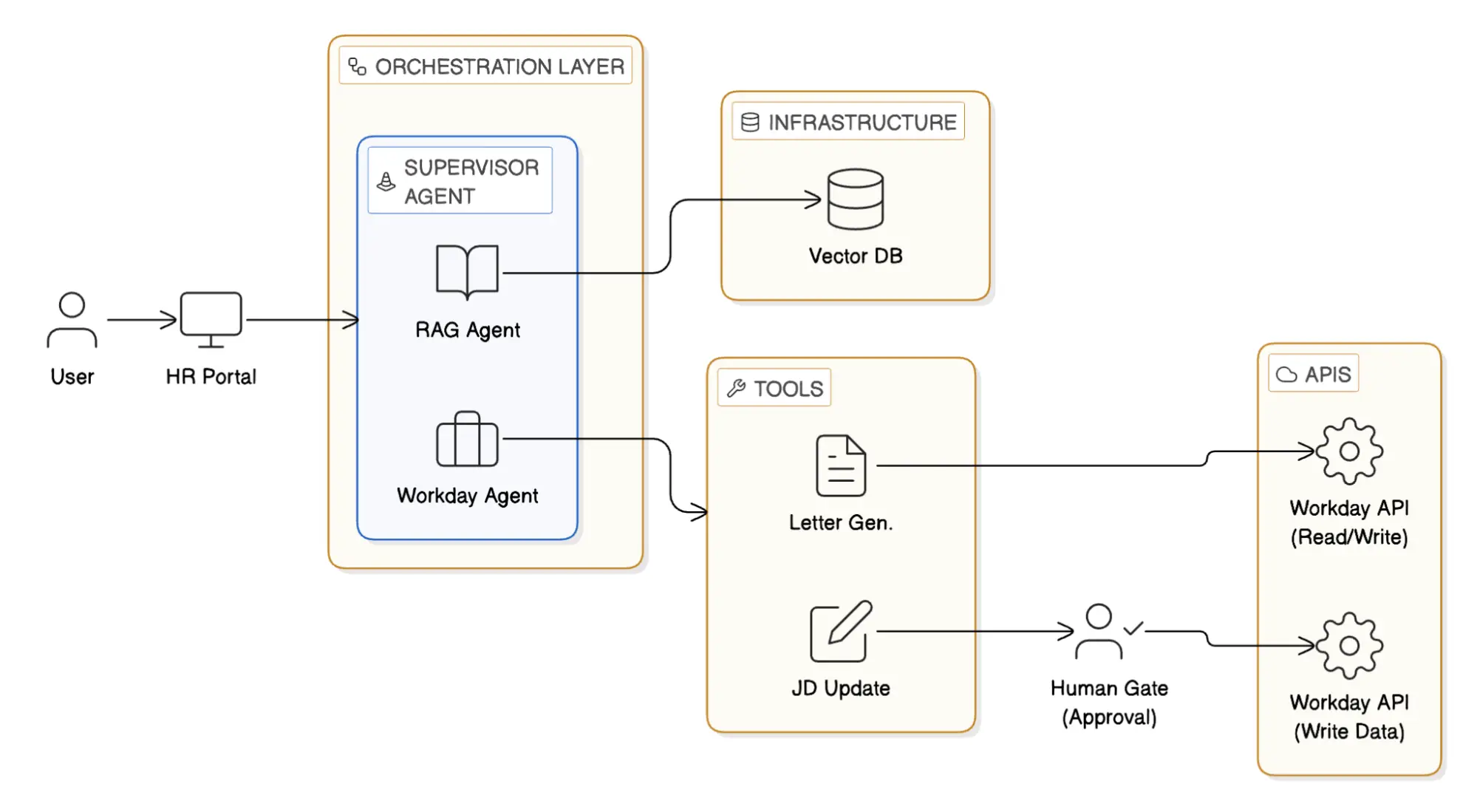
To manage the complexities of HR automation and policy-related query handling (e.g., “I need to generate an employee reference letter and update a job description”), we developed a hierarchical multi-agent architecture with three distinct layers:
The Orchestrator (Supervisor Agent)
A LangGraph-powered supervisor agent, built using langchain.agents.create_agent, which receives all user requests, performs intent analysis, and routes them to the appropriate specialized agents. The supervisor maintains the conversation state using LangGraph’s StateGraph and manages the overall workflow of HR-related operations and policy query handling.
The Specialists (Domain Agents)
Multiple specialized agents, each equipped with domain-specific tools to handle various HR and policy tasks:
- RAG Agent: This agent focuses on policy-related queries, leveraging the RAG tool to retrieve and present the relevant HR policy documents and answers to user queries about policies.
- Workday Agent: An agent designed for HR-related tasks that has two specialized tools:
- Employee Reference Letter Generator: Uses the Workday API to generate personalized reference letters for employees.
- Job Description Updater: Uses the Workday API to update job descriptions based on user inputs or organizational needs.
When a user query is received, the appropriate sub-agent is called, and the relevant tool is invoked through the Workday API to fulfill the task.
Workflow Deep Dive: The HR Task & Policy Loop
Phase 1: Intent Recognition & State Initialization
When an employee interacts with the HR-Orchestrator, the Supervisor Agent (LangGraph) immediately parses the request:
- Domain Classification: The AI determines if the request is a Policy Inquiry (requiring the RAG Agent) or a Transactional Task (requiring the Workday agent).
- Entity Extraction: The Agent identifies required parameters, such as the specific Policy ID, Employee ID for letters, or the target Job Profile to be updated.
- Context Management: Using LangGraph’s StateGraph, the system checks for missing information (e.g., if a user asks for a reference letter but hasn’t specified the recipient).
Phase 2: Multi-Agent Tool Orchestration
Unlike a standard chatbot, the HR-Orchestrator executes work through a specialized toolset:
- Tool: Policy_RAG_Search: If the intent is query-based (e.g., “What is the maternity leave policy in Germany?”), the RAG Agent queries the vector database to retrieve high-fidelity, region-specific compliance data.
- Tool: Workday_Letter_Generator: For document requests, the Workday Agent fetches employee metadata via API and generates a legally compliant PDF reference letter.
- Tool: JD_Modifier: If a manager requests a change to a job description, the agent compares the current JD in Workday against the requested changes and submits the update for approval.
- Logic Gate (Approval Flow): For sensitive tasks like JD updates, LangGraph pauses the workflow to wait for a “human-in-the-loop” approval from an HR Business Partner before finalizing the Workday write-back.
Phase 3: Verification & Execution Confirmation
Once the specialist agent completes the task, the Supervisor closes the loop:
- Validation: The system confirms the Workday API returned a “201 Created” or “200 OK” status.
- Personalized Delivery: The employee receives a summary: “I’ve updated the Senior Engineer JD in Workday and sent your reference letter to your registered email. Is there anything else you need help with?”
- Escalation Handoff: If a policy query is too ambiguous or the RAG confidence score is low, the state is transferred to a human HR representative via a Zendesk or ServiceNow ticket.
Results and ROI Analysis
The implementation of Project HR-Orchestrator transformed the enterprise’s internal service model.
- Operational Efficiency: HR Generalists reported a 65% reduction in repetitive administrative tickets, such as document generation and basic policy lookups.
- Response Latency: The “Time to Resolution” for reference letter requests dropped from 48 hours to 30 seconds, providing an immediate self-service experience.
- Compliance Accuracy: By using RAG-based retrieval, the system maintained 99% accuracy in quoting regional policies, eliminating the risk of employees acting on outdated PDF manuals.
- Scalability: The multi-agent architecture allowed the company to handle a 40% increase in HR inquiries during the annual performance review cycle without increasing HR headcount.
Executive Summary of Outcomes
| Metric | Legacy HR Operations | Project HR-Orchestrator (AI + LangGraph) | Improvement |
| Response Time | 4 – 8 Business Hours | < 20 Seconds | 99.8% Faster |
| Admin Effort | High (Call/Manual Entry) | Zero (Autonomous) | 100% Reduction |
| No-Show Recovery | Variable (Human Error) | High (Direct Workday Integration) | 15% Revenue Lift |
| Emergency Handling | Manual Search | Proactive (RAG-Verified) | Enhanced Risk Mitigation |
Conclusion: The Sovereign Patient Experience
“Project HR-Orchestrator” demonstrates that the combination of LangChain and LangGraph is more than just a chat interface; it is an Agentic Reasoning Layer for the modern enterprise.
By shifting from static portals to an autonomous “HR Service Bureau,” the organization has solved the tension between speed and compliance. Employees no longer wait days for simple documents or struggle to interpret complex legal policies. Instead, they interact with an intelligent system that understands intent, maintains state across complex workflows, and executes tasks directly within Workday.
This project serves as a blueprint for Autonomous Employee Experience (EX), proving that in a highly regulated industry, AI can be both empathetic to the employee’s needs and rigorous in its adherence to corporate standards.