
Pharmaceutical & Field Sales Distribution
INDUSTRY
COMPANY SIZE
Large Enterprise
USE CASE
Autonomous Sales Enablement, Pre-Visit Planning & CRM Automation
Introduction: From Data Entry to Conversational Intelligence
For field sales representatives, the “last mile” of productivity is often lost in administrative friction. Traditional Customer Relationship Management (CRM) mobile apps are passive databases; reps must click through multiple screens to find order history, loyalty status, or facility details. Post-visit, valuable insights are often lost or delayed due to the burden of manual data entry.
This case study explores “Sales Rep AI Assistant,” a high-performance Sales Assistant AI Chatbot built on LangChain and LangGraph. Unlike rigid command-based bots, Sales Rep AI Assistant utilizes a Single Agentic Architecture that maintains a persistent conversational state. It acts as a proactive partner, allowing reps to prepare for client visits in seconds and dictate post-visit notes naturally. By leveraging LangGraph’s cyclic graph capabilities, Sales Rep AI Assistant orchestrates data retrieval and write-back operations seamlessly, transforming the sales rep’s workflow from “searching and typing” to “briefing and speaking.”
The Architecture: Single-Agent Loop with LangGraph
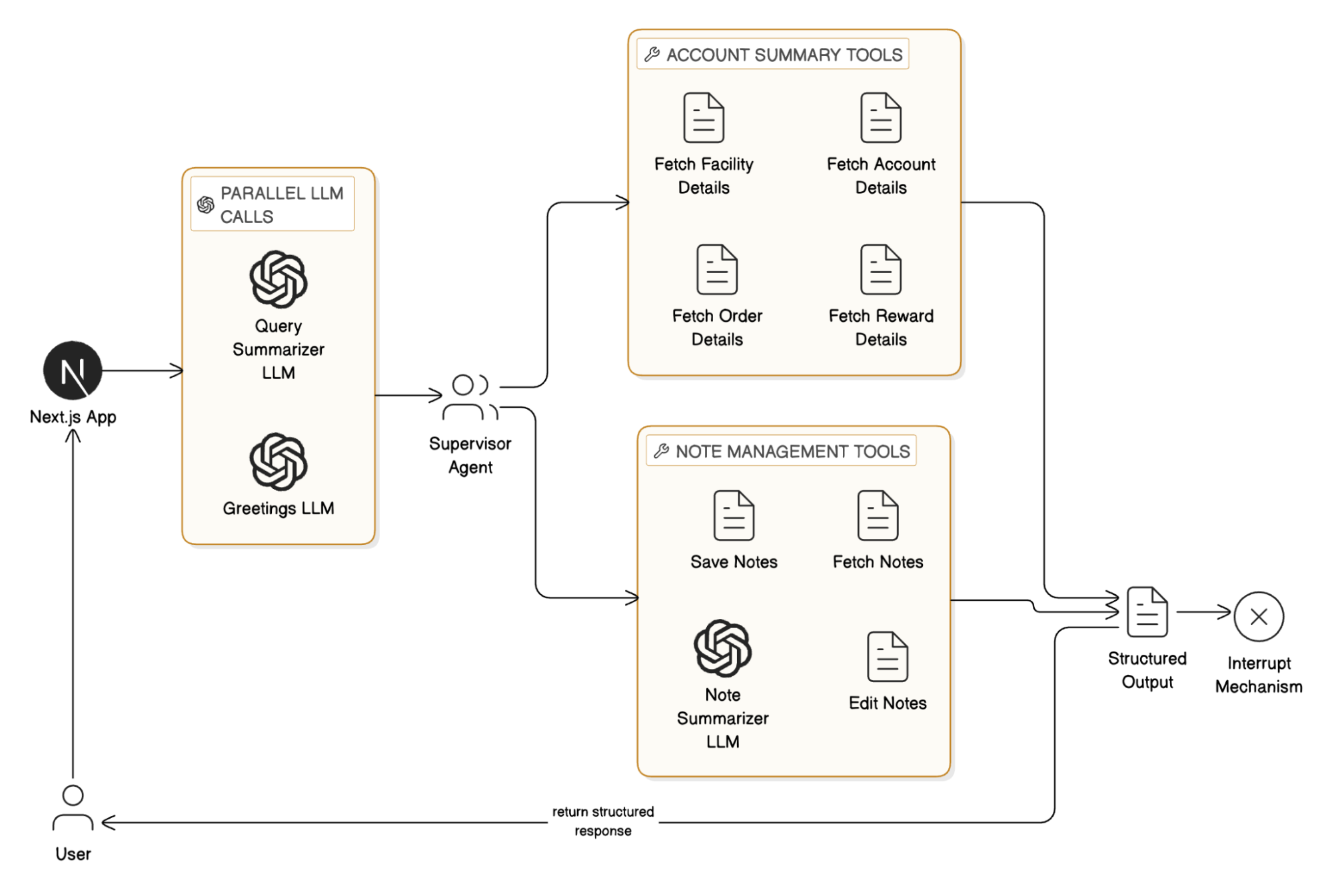
To maintain low latency and high reliability while handling diverse tasks, Sales Rep AI Assistant utilizes a streamlined Single Agent architecture. Rather than routing to multiple separate sub-agents, we employ a robust single reasoning engine that has access to a comprehensive “Tool Node.”
The architecture is defined by a LangGraph StateGraph, which manages the conversation history, tool outputs, and the iterative reasoning loop.
The Core Components
- The State Schema:
The graph maintains a messages state that appends every user interaction and tool output. This ensures the agent remembers context across a multi-turn conversation (e.g., remembering which “facility” was discussed when the user later asks, “What are their recent orders?”). - The Reasoning Engine (The Agent Node):
A central LLM node responsible for intent classification and parameter extraction. It decides whether to generate a direct response or invoke a specific tool from its bound toolset. - The Toolset (The Action Layer):
The agent is equipped with five specific functional tools to interact with the backend ERP and CRM systems:
- fetch_account: Retrieves core client metadata (KYC, credit limits, contact details).
- fetch_facility: Pulls location-specific data, shipping constraints, and facility hours.
- fetch_order: Accesses historical transaction data, open invoices, and recent product mix.
- fetch_rewards: Checks the client’s loyalty tier and available redemption points to aid in upselling.
- add_notes: A write-capability tool that structures unstructured text from the rep and commits it to the CRM.
Workflow Deep Dive: The Visit Preparation & Feedback Loop
Phase 1: Context Loading & Visit Prep
When a Sales Rep opens Sales Rep AI Assistant before a meeting and asks, “Give me a briefing for the Downtown Medical Center visit,” the LangGraph workflow initializes:
- Reasoning: The Agent identifies the entity (“Downtown Medical Center”) and recognizes the need for a comprehensive snapshot.
- Cyclic Tool Execution: The Agent may autonomously decide to call multiple tools in sequence or parallel:
- Calls fetch_account to verify the client status.
- Calls fetch_rewards to see if the client is eligible for a discount.
- Calls fetch_order to spot any declining purchase trends.
- Synthesis: The Agent aggregates these disparate JSON outputs into a concise natural language summary: “Downtown Medical is a Gold Tier client. Sales are up 10%, but they haven’t used their Q3 reward points yet.”
Phase 2: Real-Time Interaction Handling
During the conversation, if the Rep asks a follow-up like, “Do they have any shipping restrictions?” the LangGraph state retains the context of “Downtown Medical Center.”
- State Retention: The Agent knows the subject remains the same without re-prompting.
- Precision Retrieval: The Agent invokes fetch_facility, parses the specific logistics field, and returns: “Yes, they only accept deliveries between 8:00 AM and 11:00 AM at the rear dock.”
Phase 3: Post-Visit Action (The add_notes Tool)
Immediately after the meeting, the Rep dictates: “Great meeting. They are interested in the new X-Series. Log that they want a demo next Tuesday.”
- Unstructured to Structured: The Agent parses this raw text.
- Execution: It invokes the add_notes tool.
- Confirmation: The tool API returns a success status (e.g., 201 Created), and the Agent confirms to the user: “Note saved. I’ve tagged it with ‘Opportunity: X-Series’ and set a reminder for next Tuesday.”
Results and ROI Analysis
The implementation of Sales Rep AI Assistant shifted the sales force from administrative heavy-lifting to high-value client interaction.
- Visit Prep Efficiency: Time spent preparing for account visits dropped by 70%. Reps no longer traverse 4-5 different dashboard screens; the Agent aggregates the data instantly.
- Data Hygiene: The usage of the add_notes tool resulted in a 40% increase in CRM entry completion. Because the interface is conversational and low-friction, reps record details immediately rather than waiting until the end of the week.
- Upsell Conversion: By surfacing loyalty data via fetch_rewards automatically during prep, reps identified 25% more upselling opportunities utilizing unredeemed points.
Executive Summary of Outcomes
| Metric | Legacy CRM App | Sales Rep AI Assistant (LangGraph Agent) | Improvement |
| Pre-Call Prep | 10–15 Minutes (Manual Search) | < 30 Seconds (Instant Summary) | 95% Faster |
| Field Notes | Typed manually end-of-day | Real-time Dictation/Chat | Real-time Sync |
| Data Context | Siloed (Orders vs. Facilities) | Unified (Context Aware) | Enhanced Insight |
| Adoption Rate | Low (Used only when forced) | High (Daily Companion) | High Engagement |
Conclusion: The Sovereign Sales Experience
“Project Sales Rep AI Assistant” demonstrates that a single-agent architecture, when orchestrated correctly with LangGraph, is sufficient to handle complex, domain-specific workflows without the overhead of multi-agent complexity.
By giving the Agent direct access to the “Big 5” tools (account, facility, order, rewards, notes), Sales Rep AI Assistant empowers Sales Representatives to focus on their core competency: building relationships. The system handles the technical complexity of API calls and state management in the background, providing a seamless, robust, and highly scalable assistant that drives revenue and data consistency. Sales Rep AI Assistant is not just a chatbot; it is the modern interface for the mobile workforce.