
Healthcare / Health Maintenance Organizations (HMO)
INDUSTRY
COMPANY SIZE
Enterprise Healthcare Platform
USE CASE
Autonomous Multi-Persona Healthcare Operations & Intelligent Workflow Orchestration
Introduction: From Single-Agent Chatbots to Multi-Agent Intelligence
The traditional healthcare AI model is often a “one-size-fits-all” chatbot. A single agent attempts to handle everything from patient appointment scheduling to insurance claim processing to treatment planning. This approach creates a critical bottleneck: the agent either becomes too generalized (losing domain expertise) or too complex (becoming unmaintainable and error-prone).
This case study explores “Project HMO,” a sophisticated multi-agent healthcare platform built with LangChain and LangGraph. By orchestrating specialized AI agents through a supervisor-agent architecture, the system moves beyond simple question-answering to comprehending complex healthcare workflows and executing multi-step operations autonomously. This creates a “Self-Coordinating Healthcare System” that routes requests intelligently, maintains context across sessions, and handles intricate clinical and administrative workflows without human intervention.
The Architecture: Agentic Reasoning with LangGraph
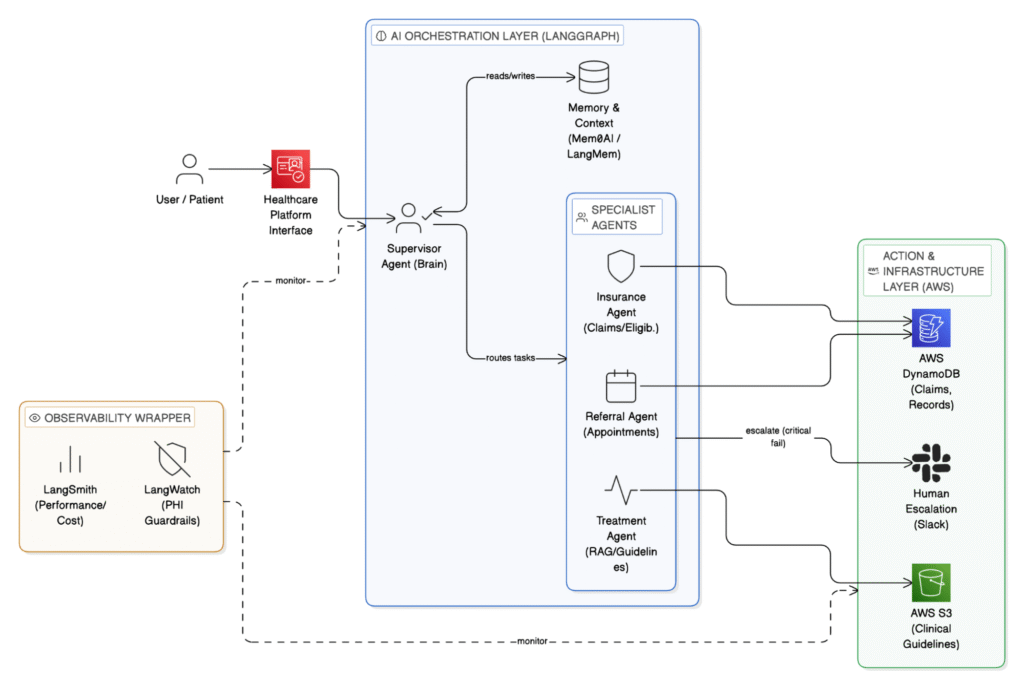
To handle the nuance of healthcare operations (e.g., “I need to file a claim for my recent surgery and also schedule a follow-up with my cardiologist”), we built a hierarchical multi-agent architecture with three distinct layers:
The Orchestrator (Supervisor Agent)
A LangGraph-powered supervisor built with langchain.agents.create_agent that receives all user requests, performs intent analysis, and routes to specialized agents. This supervisor maintains conversation state using LangGraph’s StateGraph and manages the overall workflow.
The Specialists (Domain Agents)
Five specialized ReAct agents, each built with LangChain’s agent framework and equipped with domain-specific tools:
- Insurance Agent: Processes claims, verifies coverage, checks eligibility via DynamoDB queries
- Patient Steward Agent: Manages patient onboarding, generates health summaries, coordinates care
- Treatment Plan Agent: Generates personalized treatment recommendations using RAG with clinical guidelines
- Referral Agent: Handles specialist referrals and appointment coordination
- Intake Agent: Conducts patient intake, symptom assessment, and triage
The Memory & Knowledge Layer
- Mem0AI & LangMem: Persistent conversation memory that maintains patient context across sessions
- DynamoDB: Real-time patient records, appointments, insurance data, and clinical information
The Action Layer (AWS Integration)
Each agent autonomously decides whether to query databases (DynamoDB), retrieve documents (S3), authenticate users (Cognito), or invoke custom MCP tools for specialized healthcare operations.
Workflow Deep Dive: The Insurance Claim Processing Loop
Phase 1: Intent Classification & Agent Routing
When a patient submits a request (e.g., “I need to file a claim for my recent MRI and check if it’s covered”), the LangGraph supervisor immediately performs multi-step reasoning:
- Intent Detection: Identifies multiple intents: (1) Insurance claim filing, (2) Coverage verification
- Agent Selection: Uses LangGraph’s conditional branching to route to the Insurance Agent
- Context Injection: Passes patient context (patient_id, session_id, conversation history) via LangGraph state
Phase 2: Autonomous Database & API Interaction (Agentic Tools)
- Coverage_Verification Tool: Queries DynamoDB InsurancePolicies table
- Claim_Submission Tool: Writes new record into DynamoDB Claims table (status: Pending Review)
- Logic Gate: Prior authorization check → routes back to supervisor → engages Patient Steward Agent
Phase 3: Multi-Agent Collaboration & RAG Enhancement
- Cross-Agent Consultation: Insurance Agent calls Patient Steward Agent as tool
- State Persistence: LangGraph checkpointing
Phase 4: Empathetic Response & Confirmation
- Personalized Confirmation Message
- Proactive Follow-up Scheduling
- Human Escalation via Slack (Optional)
Observability, Testing, and Compliance
LangSmith: Production Observability
LangSmith provides end-to-end visibility across the entire multi-agent system:
- Full tracing of agent decisions and tool calls
- Latency, token usage, and cost metrics per agent
- Prompt A/B testing and model comparison
- Debugging of failed or stalled workflows
LangWatch: Quality and Safety Assurance
LangWatch continuously enforces quality and safety controls:
- Hallucination detection for policy and clinical outputs
- Bias and fairness evaluation
- Real-time guardrails for PHI protection
Results and ROI Analysis
Executive Summary of Outcomes
| Metric | Legacy Single-Agent | Project HMO (LangGraph) | Improvement |
| Response Accuracy | 77% | 94% | +17% |
| Avg Response Time | 8.2s | 3.1s | 62% Faster |
| Conversation Completion | 68% | 91% | +23% |
| Manual Processing | High | Low | 40% Reduction |
| Context Retention | Session-only | Cross-session | Persistent |
| Agent Specialization | Generalized | 5 Experts | High Accuracy |
Conclusion: The Sovereign Healthcare Experience
“Project HMO” demonstrates that LangChain and LangGraph form a Clinical & Administrative Reasoning Layer for healthcare.
Core Capabilities:
- Intelligent Routing
- Stateful Workflows
- Dynamic Collaboration
- Graceful Human Escalation